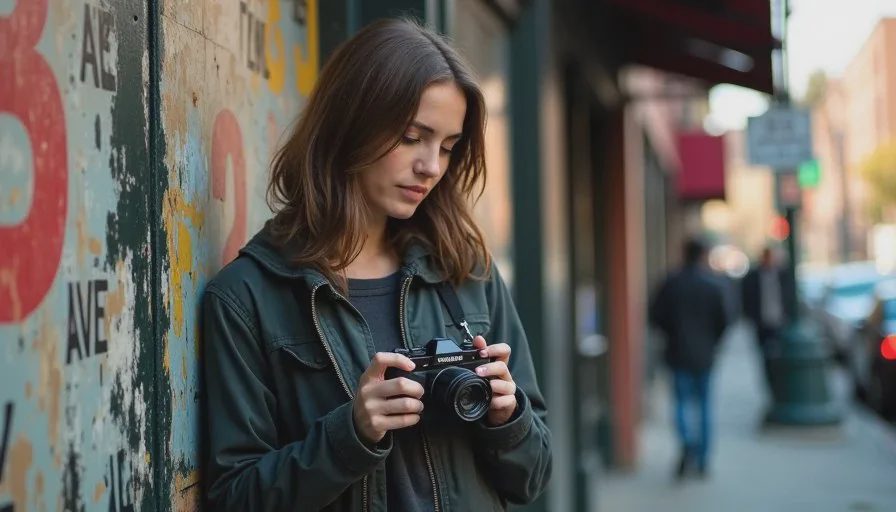
I carry a small film camera through Brooklyn most weeks. An Olympus XA or a Contax T2, depending on the day. The point is not nostalgia. The point is calibration. After enough time looking at AI-generated images, the film camera becomes a useful counterweight. It keeps showing me things the models still rarely get right.
AI image generation has become very good at producing polished, coherent frames. It is less consistent at producing frames that feel observed rather than assembled. The difference matters when the work is supposed to carry a brand, a place, or a point of view.
This is not an argument against using AI for visual work. I use it constantly. It is an argument for knowing what still has to be supplied by human attention. The film camera is one of the tools that keeps that attention sharp.
The Difference Between Assembled and Observed
Most AI images are assembled. The model combines learned patterns of light, composition, surface, and subject into a frame that satisfies the prompt. The results can be striking. They can also feel weightless. Nothing in the image had to exist before the prompt was written.
A photograph made on film is observed. The light was either available or it was not. The moment either held or it collapsed. The materials in the frame had histories that predated the exposure. Those constraints produce a different kind of specificity.
When I review AI brand photography or visual concepts, I am often looking for the absence of that observed quality. The lighting is plausible but uncommitted. The surfaces are clean but lack the residue of use. The composition is balanced but carries no evidence of a decision made in real time under real conditions.
The film camera does not automatically solve this problem. It simply makes the problem harder to ignore.
What the Camera Keeps Capturing
Walking through Greenpoint, Williamsburg, Red Hook, and the Lower East Side with a loaded camera produces a running list of visual facts that AI still tends to smooth over.
Imperfect light appears constantly. Late afternoon sun hitting a hand-painted sign at an angle that creates both clarity and glare. Fluorescent light mixed with daylight inside a small hardware store. The flat, colorless light of a cloudy morning on brick. These conditions are rarely glamorous. They are specific.
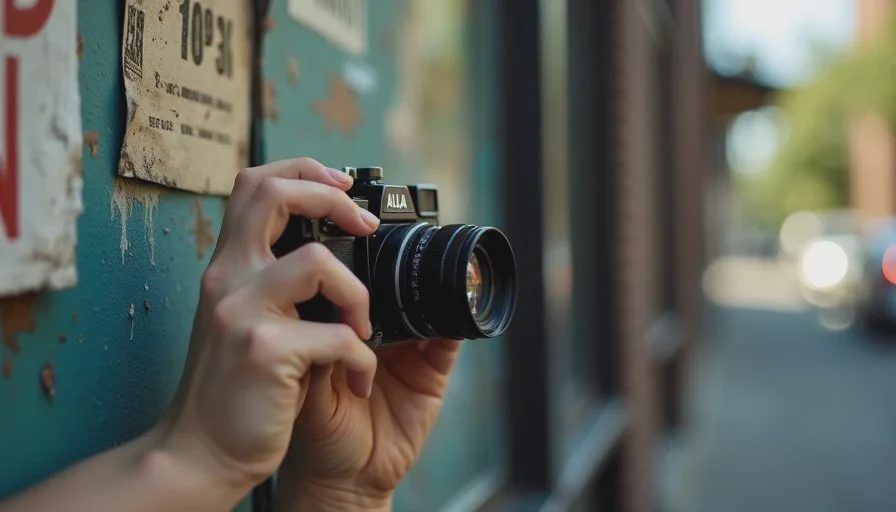
Surface residue shows up everywhere. Layers of old posters on a construction hoarding. Paint worn through on a metal railing. The particular way dust sits on a window ledge above a busy sidewalk. AI can approximate texture. It less often approximates the evidence of time and weather acting on a real object.
Unstaged relationships between objects keep appearing. A stack of leftover menus held down by a single stone. A bicycle locked to a signpost in a way that partially blocks a storefront. These arrangements were not designed for a photograph. They simply existed. That lack of design intention is part of what makes them useful as reference.
Human presence without performance is another recurring subject. Someone waiting for a light. Someone carrying a chair down the sidewalk. Someone locking up a shop at the end of the day. The postures are ordinary. Ordinary postures are harder for models to generate without sliding into either stiffness or exaggeration.
None of these elements are impossible for AI to approximate. They are simply easy for AI to avoid. When the prompt does not demand them, the model defaults to cleaner, more resolved, more generic solutions.
How I Use Film as a Reference System
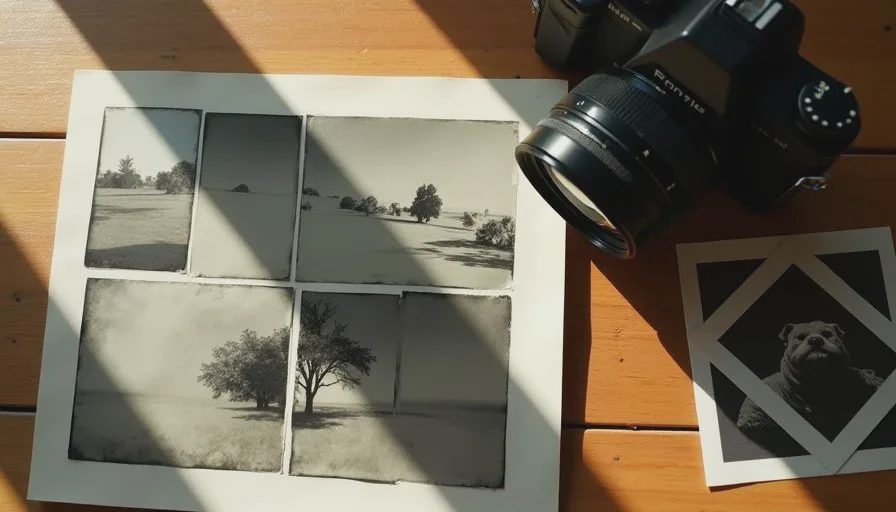
I do not treat the film photographs as sacred. I treat them as evidence. After a walk I look at the contact sheets or scans and ask what the frames actually recorded that I might otherwise have forgotten to demand from an AI system.
Useful observations get written down as constraints or rejection criteria. Soft even daylight that could be any season and any city gets flagged as a default to avoid. Surfaces that look newly manufactured without signs of use get flagged. Compositions that feel designed rather than found get flagged.
These notes become part of the direction process when I work with AI on brand or editorial visuals. Instead of asking for “authentic” or “documentary-style” images, I can point to specific qualities the film camera keeps returning: a particular quality of reflected light on painted metal, the way a shadow falls across uneven pavement, the density of visual information in a real storefront window.
The photographs also serve as a check on my own habits. If I have not made any frames that surprise me in a few weeks, it usually means I have started seeing only what I already know how to prompt. The camera pushes back against that narrowing.
What AI Still Handles Better
It is worth being precise about the other side of the comparison. AI is faster at producing controlled variations. It can maintain character consistency across many frames. It can generate lighting conditions that would be expensive or impossible to create on location. It can explore visual territories at a scale that walking and shooting cannot match.
These strengths are real. They become more useful when they are paired with standards that come from observed reality rather than from other generated images. The film camera supplies some of those standards. So do material samples, printed matter, and time spent looking at how light actually behaves on real streets.
The goal is not to make AI images look like film. The goal is to keep the direction of AI images accountable to qualities that exist outside the model’s training average.
Practical Ways to Bring Observed Qualities Into AI Work
A few methods have proven consistent.
First, collect specific visual facts before generating. Not moods. Facts. The color of a particular painted door after rain. The way fluorescent light mixes with daylight in a small shop. The density of overlapping posters on a construction wall. These facts become constraints.
Second, build rejection lists from real observation. If the film camera keeps showing you that real environments contain visual noise, then perfectly clean environments in AI output can be treated as a default to question.
Third, use real photographs as primary references rather than as secondary mood. When the model is given a precise observed frame as a reference, it is more likely to retain some of the awkwardness and specificity that make the original useful.
Fourth, allow unfinished or transitional states. Real places are rarely in a final state. AI images often look resolved. Directing toward transitional conditions—partially painted walls, temporary signage, light that is about to change—can reduce the polished weightlessness that makes so much generated work feel like expensive wallpaper.
The Larger Habit
Carrying the film camera is less about the photographs themselves and more about maintaining a practice of attention. The camera forces a slower looking. It makes the cost of each frame visible. That cost changes what seems worth recording.
AI removes most of that cost. The removal is liberating and also flattening. Without some counter-practice, it becomes easy to accept the model’s version of the world as sufficient.
I do not need every AI image to look like it was shot on film. I need the people directing those images to keep noticing what the film camera still records without being asked: imperfect light, surface history, unstaged relationships, and the ordinary postures of people who are not performing for a lens.
Those details are not decorative. They are evidence that the image is accountable to something that existed before the prompt. In brand and editorial work, that accountability is often the difference between an image that feels specific and an image that feels merely produced.
What Remains Useful
Models will keep improving at simulating observed qualities. Some of the gaps I notice today will narrow. The underlying need for human direction will not disappear. Someone still has to decide which qualities matter for a particular piece of work and which defaults should be rejected.
The film camera is one way of staying practiced at that decision. It is not the only way. Any sustained attention to real environments, materials, and light can serve a similar function. The point is to keep feeding the direction process with evidence that did not originate inside the model.
When I open an image model now, I try to bring that evidence with me. The prompts get more specific. The rejection criteria get clearer. The surviving images are less likely to look like they could belong to anyone.
The camera does not make the AI work better by itself. It makes the person directing the work harder to satisfy. In the long run, that is the more useful contribution.
Travellers Write
No letters yet — be the first traveller to write.